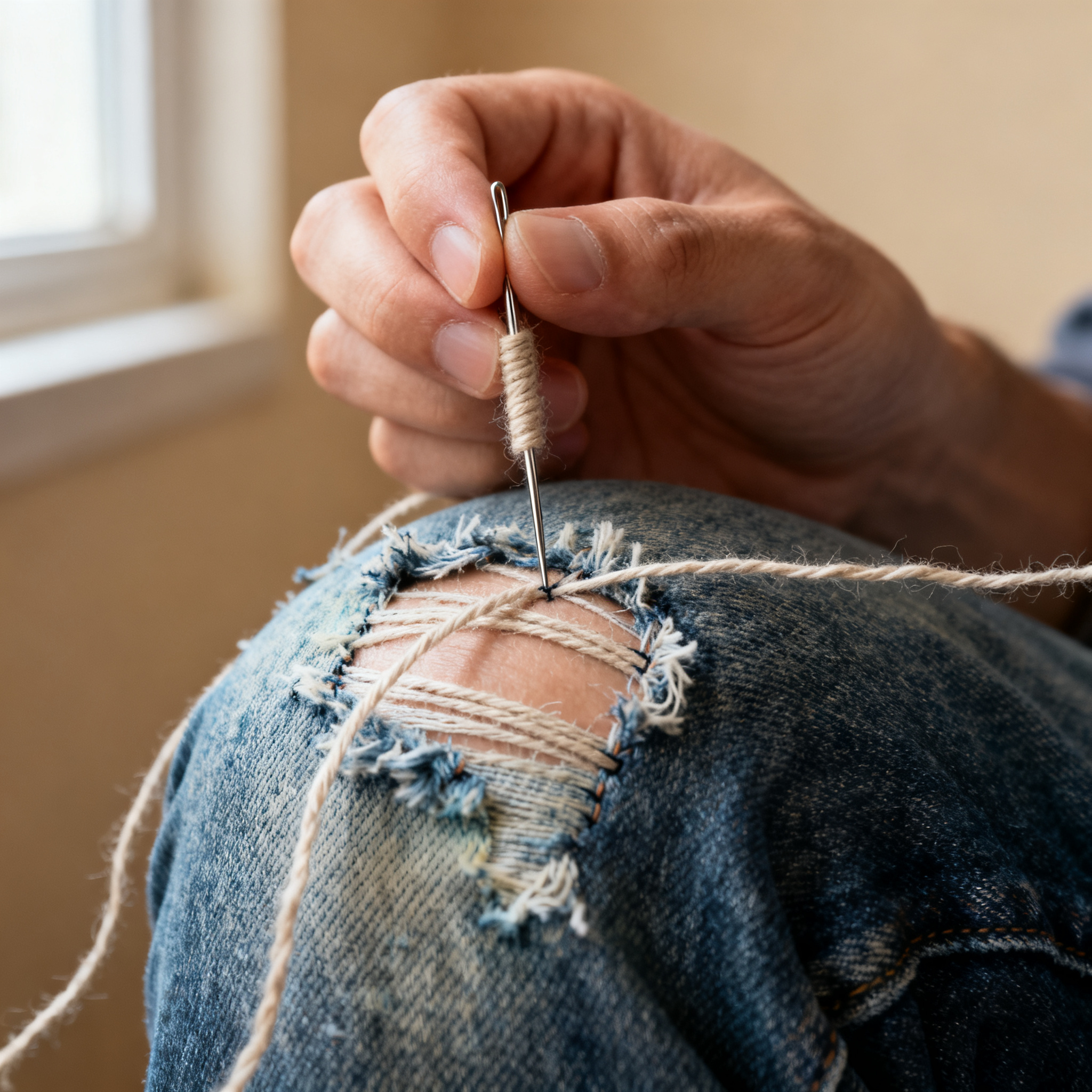
Visible mending has become a fashionable way to repair clothes, with decorative stitches turning damage into design. But fashion is not evidence. The question of whether visible mending actually makes a garment last longer than an invisible repair — or than no repair at all — has no answer in the available record. No supplied study, test, or dataset compares repair techniques by their effect on garment longevity.
That gap matters because the choice of repair method is often presented as an environmental one. The logic runs: repair extends the life of a garment, so repairing is better than replacing. The logic is reasonable, but the specific claim about visible mending rests on an assumption, not a measurement. A repair that looks beautiful may hold up well, or it may fail sooner than a less decorative stitch. Without a controlled comparison, neither outcome can be stated as fact.
What would a real test look like? It would start with identical garments, damaged in the same way — a torn seam, a worn elbow, a hole in a pocket. Half would be repaired visibly, half invisibly, and a third set left un-repaired as a control. All would be worn under the same conditions for a defined period. The outcome would be measured in months of continued wear, not in appearance. That kind of test produces data. A tutorial produces technique.
The repair movement has grown substantially in Europe, and that growth has brought legal recognition. Germany’s Ecodesign Act, passed by the Bundestag, grants volunteer repair initiatives a legal right to spare parts and repair information that manufacturers must make available to professional repairers. This is a real gain for the practice of repair: it means more people can obtain the parts and information needed to fix products at all. But the law addresses access, not outcomes. It does not tell you whether a visible darn outlasts an invisible patch.
Repair events across Europe teach skills. International Repair Day, now in its tenth year, has included textile workshops at the Museum of Making in Derby and a city-wide repair festival in Vienna. These events are where beginners learn visible mending. They are also where the missing data could be collected. A repair café that records how long a mended garment stays in use — six months, a year, five years — is building the evidence that no single tutorial can provide.
Until that evidence exists, the honest position is not that visible mending fails to extend garment life. It is that the claim remains unverified. A decorative repair may well outlast an invisible one; the stitch density and thread choice could make it stronger. But “may” is not “does.” The burden of proof sits with the claim, and the proof has not been supplied.
What you can do today is ask a question. When you take a garment to a repair café or a textile workshop, ask whether they track how long mended items stay in use afterwards. If they do not, suggest they start — a simple log of repair date and garment fate would take minutes per item. If they already track, ask what the data shows about visible versus invisible repairs. You may find that no one has asked before. That is exactly the gap this article describes.
The alternative is to treat visible mending for what it is: a skill worth learning, a way to keep a beloved garment in use, and a visible statement that repair matters. Those are real benefits. They just are not the same as a proven durability advantage. Knowing the difference between the two is the first step to making a repair choice on evidence rather than fashion.